About time, Author’s Guild!

The Authors Guild Ends its Partnership with Author Solutions | The Independent Publishing Magazine.
About time, Author’s Guild!
The Authors Guild Ends its Partnership with Author Solutions | The Independent Publishing Magazine.
from spaceplace.nasa.gov
Well, the easiest place to start is to e-publish, not that print publishing is hard, but e-publishing is even easier. It only requires two things: 1. A front cover that is at least 1600 pixels wide by 2500 pixels tall. This will fit the requirements of kdp.amazon.com and smashwords.com (two of the sites I recommend you publish on, though there are others). 2. A properly formatted book. Item two is what I am going to focus on today.


There are two ways to upload your book on both Amazon and Smashwords: A formatted word doc or a mobi doc. I’ve done both and I’m not sure which is easier. I think perhaps creating the mobi file is a touch easier, but both require a bit of work on your part. Lets start with the word doc option.
For this option the best way to get it right is to follow Mark Coker’s formatting guide that he created for his Smashwords clientele. It’s free and if you follow that guide, your word doc will easily upload to Smashwords and Amazon. Sounds easy, but it does take a bit of time to do all the recommended steps.
 I am aware of two programs that allow you to create a fairly quick mobi or epub file: Jutoh and Scrivener. Mobi is used for kindle and epubs are used for everyone else (nook, kobo, ipad or any other android reader). I have viewed a webinar for Scrivener and it looks like a fine program – has a few more bells and whistles and probably works better for non-fiction authors since it’s a lot easier to move chapters around and you can load websites very easily. But I purchased Jutoh and have been happy with the results. Both programs cost approximately $40, by the way. Very reasonable!
Jutoh: Jutoh is pretty easy to use. There is a small learning curve (as their would be with Scrivener) and Jutoh has a very good user’s guide/help section to the program if you need it. The nice thing about both of these programs is that you can upload you book and create the links to each chapter without all the putzing needed when working with a word doc. You can also easily put in hyperlinks to your book’s website or sites to buy your other books – if you have more than one. **Be aware that Amazon and Smashwords don’t accept documents that have links to other people’s websites, so don’t put them in. They will make you take them out.
One other caution for Jutoh specifically – I recommend you use Jutoh’s styles when formatting your book (centering, special formatting), it will look better in the end product. One time-saver for you is if you put in page breaks in the word doc that you download to Jutoh, it will automatically make these the chapters breaks. You can do it within the program, but doing it in word first will save you time. Just pick the “chapters by page break” option when setting it up in Jutoh.
Once it’s uploaded and formatted the way you want (remember no fonts bigger than 16 point or unusual fonts – ereaders aren’t sophisticated enough to handle these things) you pick the format you want. As mentioned, for kdp.amazon you want the mobi format. Smashwords will also accept mobi files, so you might as well start there. When you’ve selected mobi you hit “compile” and the program will create a folder in your computer’s “document” file titled “Jutoh Documents.” It will put the mobi and Jutoh file there. The nice thing about Jutoh is that if you hit the “error” tab at the bottom of the Jutoh screen, it will show you all the mistakes you make and tell you what the error is. If you click on a error message, it will take you to that error in your document. How cool is that! 
The next step is to check the document. For kindle, download the free kindle reading app for PC or Mac. Look through the whole document for formatting issues and make sure the chapter and web links work.
 I always create a epub file because not everyone has a kindle and when giving away free copies of the book, it’s nice to have that option. Obviously, ebooks are a lot cheaper to give away than paper books. To create a epub file, pick the epub option then compile again. Correct any errors, then download Adobe’s Digital Editions. Digital Editions reads epubs. This link will give you the program for either PC or Mac formats. Now it’s time to visit Smashwords and kdp.amazon and set up your accounts. Both sites make it very easy to upload your cover and interior files. Then let everyone know it’s there! If you have any trouble with this process, don’t hesitate to contact me.
 Christine Keleny CKBooks Publishing
Where Publishing Dreams Become Reality

I am not a reader in the romance world, so I have not heard of Jamie McGuire, but it sounds like a lot of other people have. Regardless, her discussion on Mark Coker’s blog is very helpful to any author who wants to publish either the traditional way or through self-publishing or both! Thanks for sharing Mark and Jamie! Smashwords: Why Jamie McGuire Returned to Self Publishing. CKBooks Publishing Where Publishing Dreams Become Reality
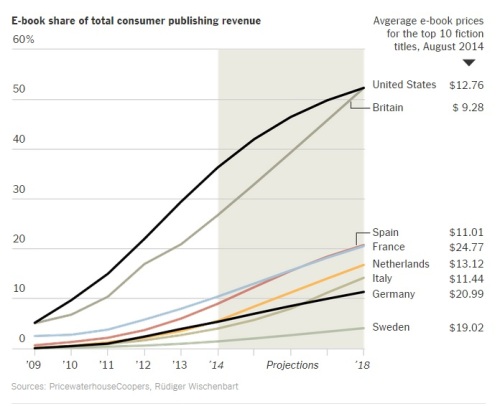 According to The New York Times:
In the United States and Britain, sales of e-books represent between a quarter and a third of the consumer book market and, by 2018, will edge out printed and audio books as the most lucrative segment, according to projections by the consulting firm PricewaterhouseCoopers.
As Nate Hoffelder of The Digital Reader points out though, the “perennial ebook optimists” at PricewaterhouseCoopers have now moved that goalpost back two years running. In 2012 they predicted that eBook sales would outpace print by 2016. In 2013, they said it’d happen in 2017. Now… it’s 2018.
One thing is certain, though: for many years to come, authors in the United Sates and Britian will need to make their books available in both print and digital editions in order to reach the most readers.
It’s also interesting to see how much less a share of the marketplace eBooks hold in many European countries. It’s exciting to see the growth opportunity for digital books in that region, but also a great chance for authors to continue selling print books to the millions of English-speakers in countries like Germany, Sweden, Norway, etc.
From Chris Robley of bookbaby
 Brooke Warner of She Writes has some good points, though I don’t agree wholeheartedly with her first point – Your first book won’t make you any money. No one knows that. It will definitely take a lot of work for your first book to make money, but it can be done. No – you can’t quit your day job, but that doesn’t’ mean a very good story, well edited, with a good cover and good reviews, can’t do very well. It happens all the time.
Does it help to write more good books and get more good reviews? Of course, but I say, never say never for anything!
Read Brooke’s post for more things to contemplate.
If you’re interested in going the traditional route (or traditional plus self-publishing – which is what I encourage people to do) then Tracy’s post is something you should read. I’m sure you can modify it for a fiction proposal. You’re a writer, after all!

[Path to Publication] How to Write a Memoir/Nonfiction Proposal – She Writes.

Mark Coker of Smashwords gives us some grim statistics, but also shares some very concrete ways to keep on keepin’ on.
I agree – looking at the long haul is the way to go. I first published in 2008 and I still get sales from that first book. For me, it’s never been about the big launch with big first sales – though there is some of that, of course. It has been more about staying the course, keeping up with my writing and publishing, picking and choosing my marketing strategies and learning new things with each new book I publish (Just published book #6 – Will the Real Carolyn Keene Please Stand Up). I don’t exclusively write and publish – I do have a day job (that I love, by the way, because it’s helping others publish!), but I am not tossing in the towel because there are a lot of others writing and publishing these days. In fact, I encourage people to write and publish (through the writing and publishing workshops I do for libraries and school children). I think there is room for everyone!

Thanks for the insights, Mark!
Nice illustrations Elizabeth!

from rahulbemba.blogspot.com
For those who aren’t sure if they want to do self-publishing, Brook Warner of Shewrites gives us some reasons why you may want to go in that direction when thinking of publishing.
It’s really a matter of your goals, your time, and your money.
As I’ve said before, I encourage anyone who asks me about traditional publishing to do self-publishing while they are trying to pitch their story to an agent or publisher. It can only help if your story does well in the self-publishing realm, and the only thing you are going to do different when you self-publish (ebooks to start) is create a cover.
Either option will cause you hire an editor (and if you are serious about making your book a commercial success, I’d encourage you to find a professional.)
And to put an ebook on say, Amazon or Smashwords, you can do that using a properly formatted word doc. Smashwords has a free guide to help you through that process, and if you want to hire someone to do that for you, it’s probably only $100+ or – depending on the size and complexity of your book design.
Are There Still Pros to Traditional Publishing? – She Writes.
Here is David Gaughran’s view on cheap ebook pricing.
I definitely think it has it’s place, whether you use it for a new book or keep your first book in your book series permanently on sale, I think those are fine marketing strategies. I would not, however, discount all of my books. I think it does give the impression that the story is not worth it. But then again, I don’t think selling a ebook for over $6 is reasonable, either. They do take money and time to make, of course, but sharing an electronic file is the least inexpensive way to share your stories and the price should reflect that.
If you haven’t read about the Amazon vs Hachette (a Book Publisher) dispute, you should take a look at the Mark Coker’s post below.
It seems to me that the agency model of publishing is on it’s way out, but only time will tell what will replace it. We (authors, indie-publishers) do work in a ever-changing field, and that’s going to be the status quo for some time, I’m sure of it.
Smashwords: Amazon’s Hachette Dispute Foreshadows What’s Next for Indie Authors.
 CKBooks Publishing